Subtle changes in L1 stops of late Salento Italian-French bilinguals: An acoustic study using autoVOT adapted for Italian and French
Abstract
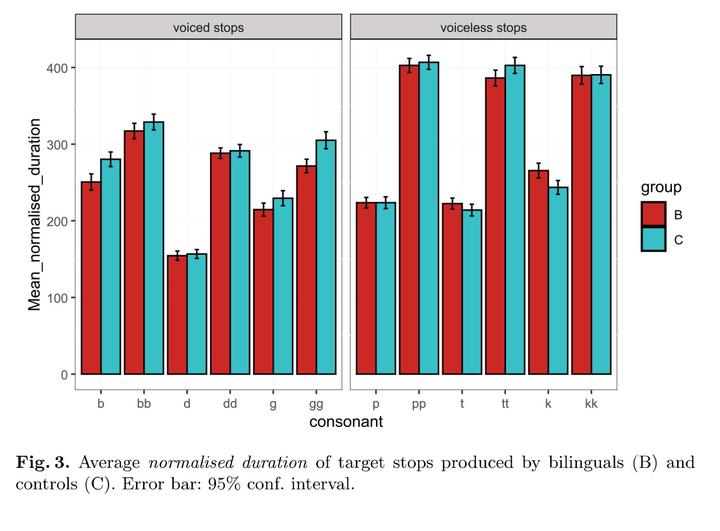
This study examines the influence of the second language (L2) on the native language (L1) of Itlaians from Salento (Southern Italy) who have started to learn French, i.e., their L2, mostly in adolescence and have moved to the Paris region as adults; they have been living in that region by different amounts of time and using French on a daily basis. Unlike French, Italian shows both geminate and singleton stops; the contrast mainly lies in stop length, even though the duration of the preceding vowel also changes. Because of this difference between langauges, we investigated, at the phonetic level, the L1 singleton and geminate stops of 15 late Salento Italian-French bilinguals by comparing their L1 speech production with that of 15 controls, who are Italians born and living in Salento. Normalised acoustic duration of the stops in word-internal intervocalic position as well as that of the vowels preceding these stops was analysed. Results on stops show that bilinguals and controls significantly differ in the normalised duration of some, but not all, investigated stops; for vowels, there is no significant difference. Another key point of this paper is the description of the version of AutoVOT adapted for French and Italian, which was developed and used to obtain an accurate normalized duration of stops and vowels in this study.