Predicting Changes in L1 Vowels of Late Czech and Italian Bilinguals with French as L2
Abstract
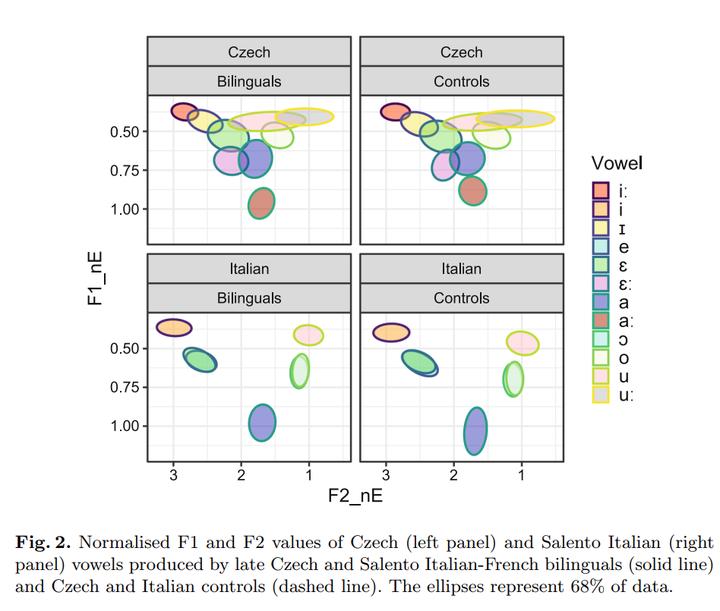
This study examines whether vowels produced in the first language (L1, here Czech and Italian) by Czechs and Italians who moved to France as adults (i.e., late bilinguals, hereinafter Czech and Italian B) differ from those produced by Czech and Italian control speakers (hereinafter Czech and Italian C). Czech, Italian and French vowels differ in spectral characteristics, here examined by measuring the first and second formant (F1, F2). Consequently, L1 vowels of Czech and Italian B may ‘change’, that is, differ from those of Czech and Italian C since their second language (L2, here French) may influence their L1. We examined whether these changes in L1 vowels of Czech and Italian B could be predicted by a complex combination of non-linguistic factors relevant to late bilinguals. Significant results discussed in light of the Speech Learning Model and Attrition and Drift in Access, Production, and Perception Theory show that Italian B and C produce /i/, / /, /o/ and /u/ differently with respect to F1 and /e/ and / / with respect to F2, and Czech B and C produce /a / and / / differently in terms of F1. We propose a model incorporating a combination of non-linguistic factors which, out of the 20 models tested, predicted the best the occurrence of changes in L1 vowels of our late bilinguals; on the contrary, individual non-linguistic factors were not sufficient to predict them. Future research will confirm if this model may be generalised for reliable predictions of phonetic changes in the L1 of late bilinguals.